On The Art of Losing Oneself: Lessons from Klavdij Sluban
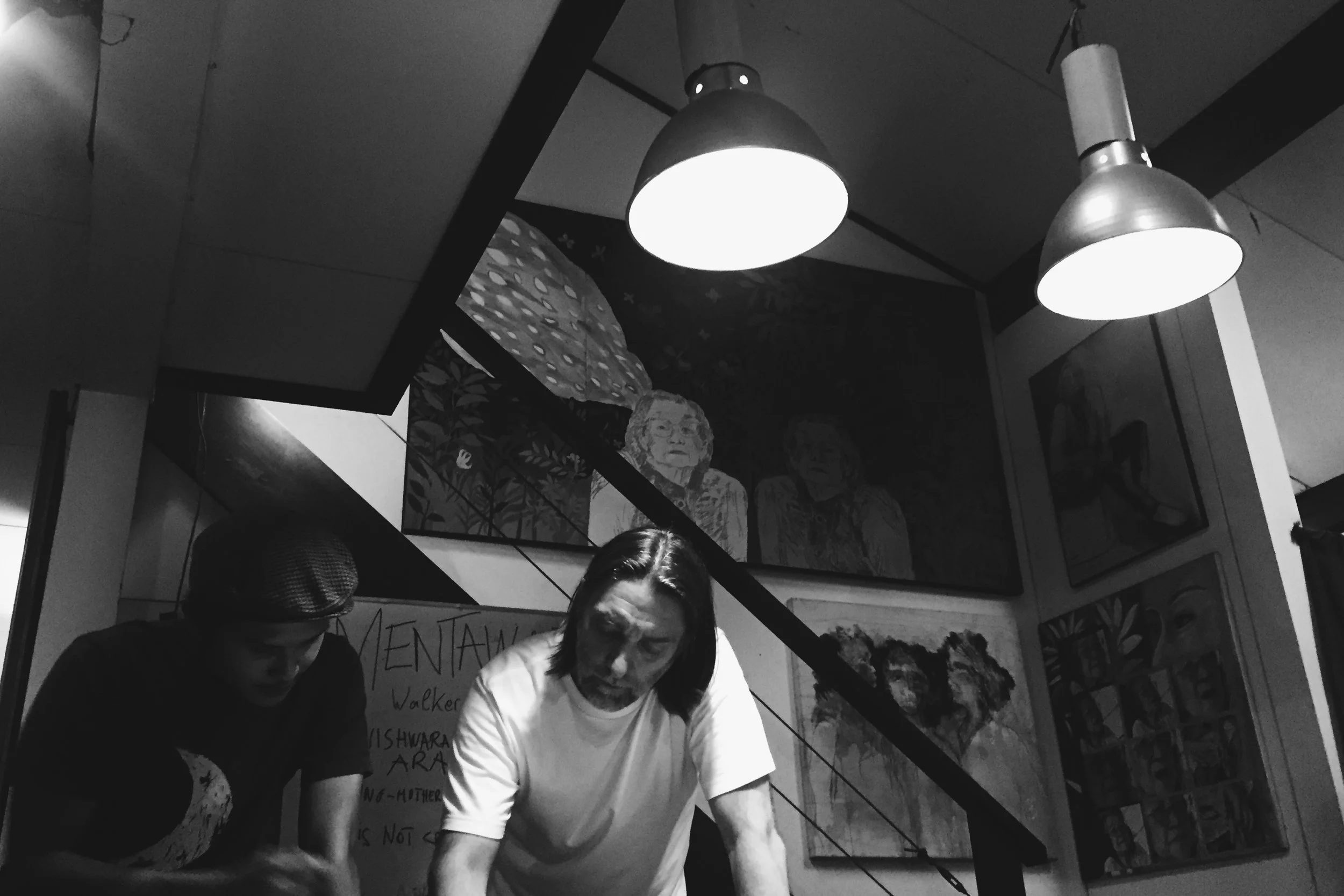
“I travel to lose myself. I love losing myself. Because when you find yourself—well, you can only find yourself by losing yourself first.”
I first encountered the work of Klavdij Sluban in the early 2000s, while watching L’amour de court (Just Plain Love), a documentary about Henri Cartier-Bresson. In the film, Bresson featured several French photographers he admired; one of them was Sluban.
At the time, Sluban was in his late twenties, a young photographer immersed in a long-term project documenting daily life in adolescent prisons across several countries. What struck me wasn’t just his haunting images, but his method: he conducted photography workshops for these incarcerated youths, giving each child a disposable camera to capture their own world.
Since then, I have followed his work closely. However, it wasn't until recently that I finally had the chance to meet him during a workshop in Indonesia back in 2017.
When I met him before the session began, we exchanged smiles. With his long grey hair, plain white casual suit, and sandals, my first impression was of a man who was remarkably low-profile. Within two hours, I realized he also possessed a sharp sense of humor. Unlike his photographs—which are often dark, gloomy, and at times depressive—the man himself, now in his early fifties, is warm and wise.
He opened the workshop by introducing himself as a penguin. Specifically, a penguin he had photographed in the Kerguelen Islands, a desolate archipelago in the southern Indian Ocean near the South Pole. Sluban was the first photographer granted an artistic mission there.
“I was walking, and suddenly I saw this one,” he joked, gesturing to the image. “It is very difficult for them to walk away from the group. When I saw him, I felt my own desperation on that island. It takes two weeks by boat from North Africa to get there. I saw this little penguin and thought, ‘That’s me.’”
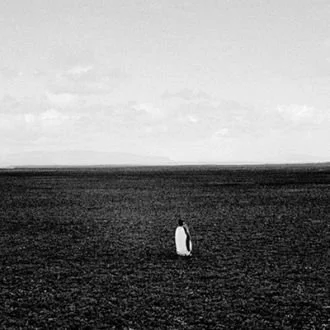
In his series Happy Days on Desolation Island, first shown at the Rencontres d’Arles Festival in 2012, Sluban presents his impressions of living in such extreme isolation. “It’s very difficult to travel,” he noted. “It’s impossible to be with others, to cope with others, but still, you have to live on.”
Sluban eschews traditional assignments, preferring to choose his own paths. His journeys are legendary: the Black Sea (Balkan Transit), Tokyo (Winter Travels), Jerusalem (Paradise Lost), and the Trans-Siberian railway (Transsibérades).
“This is the way I like to travel: slow and meditative. No internet connection,” he explained. “Nowadays, to be connected, you first have to be disconnected.”
Throughout his career, Sluban has remained faithful to black-and-white photography, using deep, empathetic shadows as his trademark. Yet, he insists that the darkness lies in the eye of the beholder. In every photo, there is a "highlight"—a bright point meant to be reached through the dark.
“The first person I meet when I travel is myself,” he said. “It’s not always a good encounter. As you can see, it is sometimes scary. But I try to live with it.”
During the workshop, Sluban emphasized the importance of how we show our work. He prefers digital slideshows—series of photos set to specific music—over single prints.
“It changes the perception of the body of work. I work in cycles; I never show just one photo. By showing a series, I am showing that 'reality' does not exist. What you see is different from what I see, and what your neighbor feels is different from what you feel. It is my own perception of the world, filtered through my feelings.”
This is why he avoids working for news agencies. He doesn't want to "illustrate" a story. “I work on projects I decide on because I feel a connection there. I know I will go back. I know I will feel something.”
The Geometry of Distance
In his project Entre parenthèses, focusing on young prisoners in the former Yugoslavia and Soviet Union, he bridged the gap between two seemingly opposite worlds: travel and confinement.
“Both aspects—freedom and prison—speak of exile. My family and I are exiles. It is difficult to say where ‘home’ is. But I am at home here,” he said, gesturing to the room.
He refuses to treat a jail like a zoo. “I share photography with the kids. We take photos together. I don’t show what a jail looks like; I show what I feel when I am inside.” This approach is the antithesis of modern press photography, which Sluban compares to political propaganda—designed to be understood instantly on a surface level.
“Photography is a poor tool in itself, but it can go very deep. However, it takes time. Time to be taken, and time to be looked at. I just hope my work is felt. Like music, there is 'easy listening' that you sing in the shower but soon forget. Then there is complex music that is harder to enter. Maybe my photography is the second kind.”
He concluded with a meditation on distance—the space between what he sees and what he feels.
“To know a person, you take time. To know a space, you take time. The more distance I create with the subject, the closer I get to myself. This distance keeps me away from the raw experience, allowing me to reach the core—the heart of the matter.”
It was a two-hour session well spent, leaving us all a little more disconnected from the world, and a little closer to ourselves.
My journey with Sluban’s philosophy didn’t end after those first two hours. I later joined his workshop in Bandung, an experience that added a new layer to my understanding of "the distance."
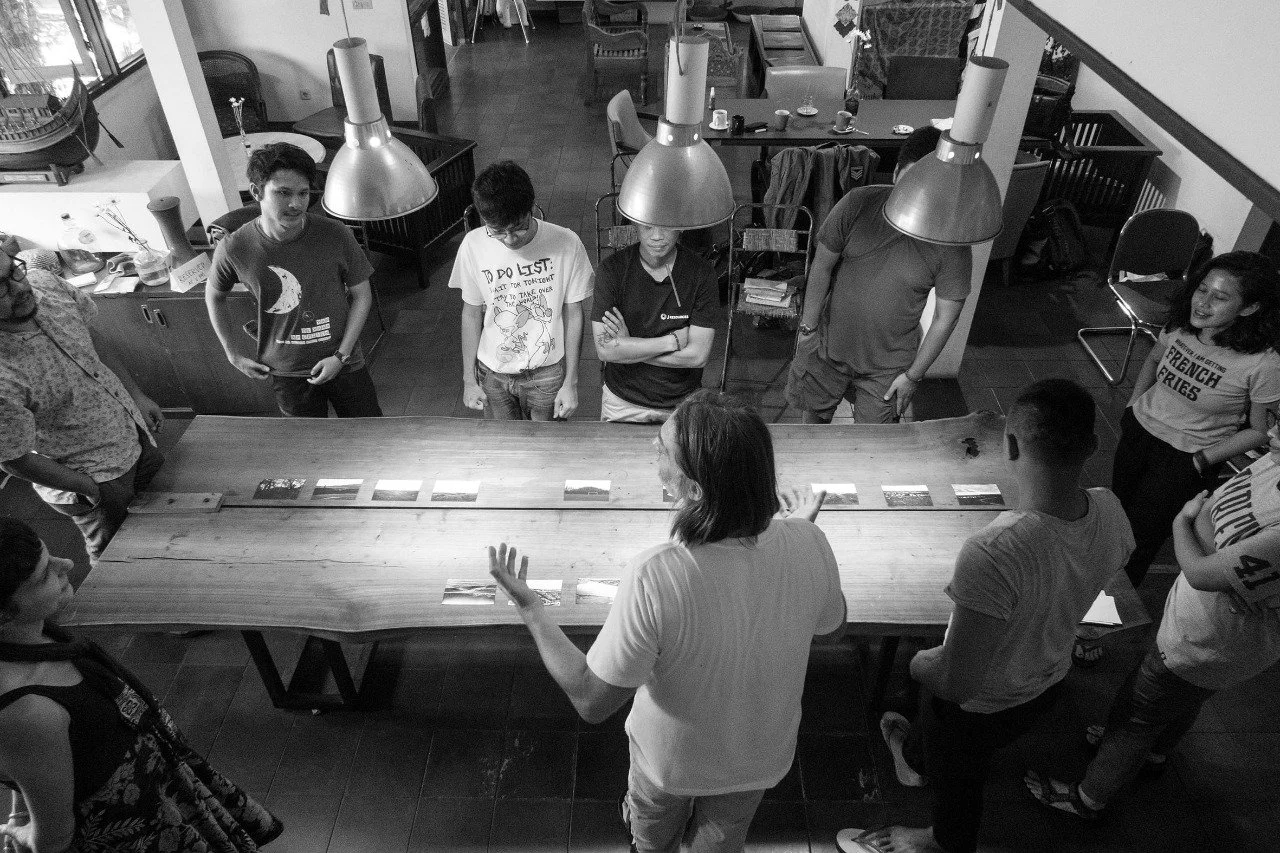
If the first meeting was about the philosophy of the image, Bandung was about the practice of it. In the cool, creative atmosphere of the city, Sluban’s ideas on "cycles" and "meditative travel" felt even more resonant. It became clear that his workshops are not just about photography; they are lessons in how to exist in the world without the constant noise of the present.
In Bandung, I saw firsthand how he looks for the "knot of life"—that point where space and time converge. It confirmed what I had suspected: that his dark, grainy frames aren't meant to be depressing. They are a form of radical honesty. By stripping away the color and the "easy" narrative, he forces us to look at the world—and ourselves—with a much sharper, more patient eye.
I left Bandung realizing that the "distance" he speaks of isn't just physical. It is the mental space we need to process our own exile, whether that exile is from a country, a home, or our own history. Through his lens, the scary and the dark become manageable; they become parts of a story we are finally learning how to tell.