On Reclaiming "Radical" and "Metaphysics"
Why restoring precision to these two deeply misunderstood terms isn't an academic exercise—it is an act of ethical self-defense in how we tell stories, interrogate power, and inhabit reality in contemporary Indonesia.
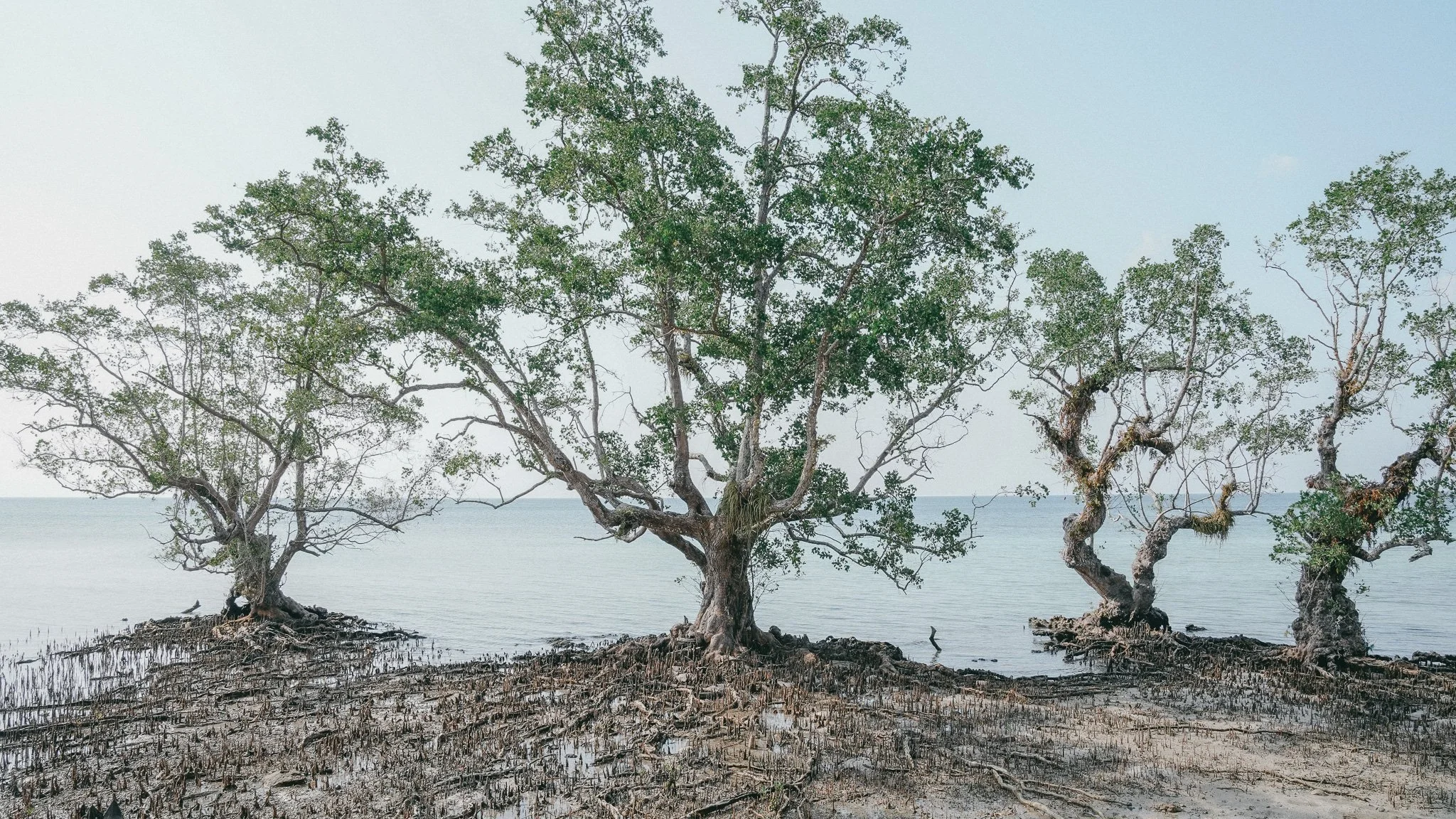
I am writing this in between drafting a documentary script and editing photographs. The film follows my subject as she traces her family roots back to the Banda Islands—where her ancestors were forced to flee during the 1621 Dutch (VOC) genocide. At the same time, I am editing a photography project that maps the pattern of resource extraction in Indonesia, linking the brutal VOC spice monopoly directly to today’s nickel mining boom. Looking at these photos and reading about lost homelands made me realize how urgently we need clear, honest language to describe our world.
Words rarely lose their meaning by accident. When we simplify complex words into basic buzzwords, we lose the tools we need to understand our history and our lives.
In Indonesia today, two words have been completely misunderstood: radical and metaphysics.
In news and politics, "radical" is used as a scary word for violent extremists. Meanwhile, "metaphysics" is usually treated as magic, ghost stories, or superstition (klenik). But for storytellers, journalists, and researchers, this loss of meaning is dangerous.
Getting these words back to their original meaning isn't an academic trick; it is an important way to protect how we think.
Looking at the Root
People fear the word "radical" because they confuse depth with violence. Today, calling someone "radical" is usually an excuse to ignore them.
However, the word comes from the Latin word radix, which simply means "root."
Being radical does not mean being violent or extreme. It means having the courage to look at the root cause of a problem instead of just fixing the symptoms on the surface.
Think of it as the difference between patching a broken system and asking why the system breaks people in the first place:
A surface fix changes small rules—like adjusting tax rates or tweaking environmental laws for mining companies.
A radical approach interrogates the underlying logic of the system itself—asking why our developmental narrative continues to replicate colonial extractive models that treat land, ecology, and human lives strictly as disposable commodities.
When we trace Indonesia's history from the VOC's violent nutmeg monopoly in Maluku to the destruction of small islands for nickel today, a radical view shows us that environmental damage isn't an accident. It is the natural result of a system that puts profit before human life. Without a radical perspective, we will keep repeating the same mistakes under different names.
Asking Big Questions
If "radical" has been turned into a insult, "metaphysics" has been turned into a joke. People treat it like a synonym for magic or superstition.
In philosophy, metaphysics is the study of reality, existence, and meaning. It asks fundamental questions that numbers and statistics cannot answer:
What does it mean to live in a place shaped by painful, forgotten history?
How is trauma passed down silently through generations of a family?
How do people carry the memory of a lost homeland for hundreds of years?
The name came from a simple mistake. Long ago, editors grouped Aristotle's books on existence right after his books on natural science (Physics). They called them ta meta ta physika—"the books after the physics." Over time, meta came to mean "what lies underneath" or "what goes beyond."
When scripting a film about a protagonist tracing her Bandanese ancestors who survived genocide and exile in 1621, the core questions encountered are fundamentally metaphysical. Intergenerational trauma and the sense of a stolen homeland cannot be fully measured through medical scans or official archives alone. Archives are often written by the victors—in this case, VOC ledgers that recorded nutmeg yields while erasing the lives destroyed to produce them.
Trauma is a structured, metaphysical experience: a palpable presence of what official history attempted to wipe out. Metaphysics gives us the framework to recognize that what is real extends far beyond what is physically visible on the surface or recorded in state documentation. It allows us to speak of memory, grief, and presence not as ghosts, but as lived, ontological realities.
Radical Metaphysics: Interrogating Our Frameworks of Reality
When we combine these two restored words, we get a powerful tool: Radical Metaphysics.
This isn't magic or extremism. Radical metaphysics is the habit of asking root-cause questions about our basic assumptions about life and history:
Is the belief that nature and people exist solely to be extracted and commodified an inevitable law, or is it an inherited colonial framework rooted in corporate violence that we continue to accept unquestioned?
How do we conceptualize memory, grief, and agency in a society conditioned by enforced historical amnesia?
What is the relationship between silence and engagement—when does silence become complicity, and how can storytelling act as an ethical intervention?
In a world full of fast news and short attention spans, radical metaphysics asks us to slow down and check the ground we are standing on. It reminds us that injustice and ecological destruction are not natural facts of life; they are human choices that we have the power to change.
Why Clear Words Matter
Losing the true meaning of words makes it harder for us to think clearly. When "radical" becomes a bad word, we lose the ability to question broken systems. When "metaphysics" becomes a joke about magic, we forget how to talk about grief, memory, and human connection.
Reclaiming these words isn't just about vocabulary. In our present context—as we navigate the ongoing legacies of colonial violence and the rapid acceleration of new extractive frontiers—it is a call for intellectual clarity and moral courage.
It is an invitation to look past surface symptoms, examine the deep roots of the systems we inherit, and remain grounded in the truth of both human narrative and the ground we walk upon.